


Product Overview
AC Voltage Stabilizer for Industrial and Commercial Applications
A voltage stabilizer regulates fluctuations in input voltage to provide a controlled output voltage for connected electrical equipment.
It is used in industrial and commercial power systems where voltage variations may affect equipment operation or electrical supply conditions.
For buyers, the main selection factors include input voltage range, output voltage, rated capacity, phase configuration, regulation accuracy, and load characteristics.
Key Selection Considerations
Voltage Regulation: Matches output voltage requirements within the stabilizer's rated operating range.
Rated Capacity: Must account for connected load, power factor, and equipment starting current.
Electrical Configuration: Single-phase or three-phase options must match the site's power supply.
Protection Requirements: Protection functions should meet the requirements of the connected equipment and operating environment.
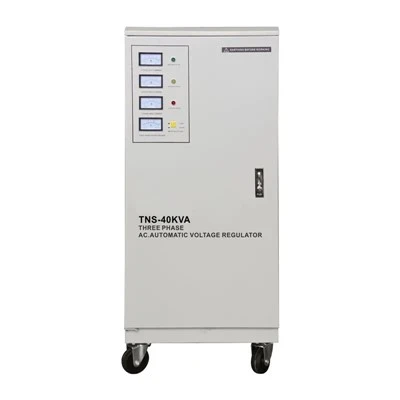
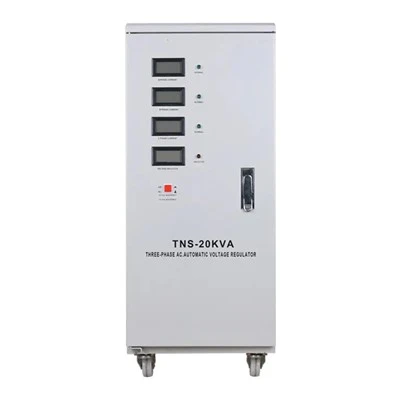
Technical Specifications
The following parameters are used to evaluate and compare voltage stabilizer models.
|
AC Input |
Single Phase 220V Nominal | Regulation Capacity: 150V to 250V Window |
|
DC Output |
220V, tolerance ±3%, servo-driven continuous regulation |
|
Core |
Cold-rolled silicon steel transformer, copper windings, airflow ventilation slots |
|
Efficiency |
>98% |
|
Protection |
Interlocked cutouts for low input sag, high surge, overload; microprocessor safety cutoff Noise: vacuum-varnished laminations, below 65dB |
Actual specifications depend on the selected model. Confirm the electrical ratings and configuration before ordering.

Input Voltage Regulation
Regulates input voltage variations to maintain the specified output voltage within the rated operating range.
Multiple Capacity Configurations
Different capacity options can be selected according to connected load requirements and operating conditions.
Single-Phase and Three-Phase Options
Electrical configurations are selected according to the power distribution system and connected equipment.
Load-Based Selection
Capacity selection considers continuous load, starting current, power factor, and load characteristics.
Protection Configuration
Available protection functions depend on the product model and electrical configuration.
Compatibility & Selection
Selecting a suitable voltage stabilizer requires matching its electrical specifications with the power supply and connected equipment.
Input Voltage Range
Check the minimum and maximum input voltage at the installation site. The stabilizer's rated input range must cover these conditions.
Output Voltage
Confirm the voltage required by the connected equipment and select the corresponding output configuration.
Rated Capacity
Calculate the total connected load and consider power factor, starting current, and simultaneous operation.
Phase and Frequency
Match the stabilizer's phase configuration and operating frequency with the local electrical system.
Load Characteristics
Motors, pumps, compressors, and other inductive loads may have higher starting current requirements. These should be considered when selecting capacity.
Installation Conditions
Check ambient temperature, ventilation, installation space, and electrical connection requirements.
Voltage stabilizers are used in electrical systems requiring regulated output voltage.
Industrial Machinery
For compatible production machinery and industrial electrical equipment requiring controlled supply voltage.
Manufacturing Facilities
For selected electrical loads in manufacturing and processing environments.
Commercial Electrical Systems
For compatible equipment installed in commercial buildings and facilities.
Motor-Driven Equipment
For compatible pumps, compressors, and motor-driven loads, subject to starting current and capacity requirements.
Application suitability depends on the stabilizer's rated specifications and the connected equipment's electrical requirements.

Quality inspection should cover key electrical components, assembly, and product performance.
Component Inspection
Electrical components and materials are checked against approved product specifications.
Assembly Inspection
Wiring connections, component installation, and enclosure assembly are checked during production.
Electrical Performance Testing
Input and output voltage conditions and voltage regulation performance are evaluated against product specifications.
Protection Function Testing
Applicable protection functions are verified according to the selected model.
Final Inspection
Product configuration, electrical ratings, appearance, and order requirements are checked before shipment.
OEM & Customization
Product configurations can be discussed according to project requirements and available manufacturing capabilities.
Electrical Specifications
Input voltage, output voltage, rated capacity, phase, and frequency.
01
Regulation Requirements
Voltage regulation range and output accuracy according to the selected model.
02
Product Configuration
Enclosure dimensions, installation arrangement, and electrical connection requirements.
03
OEM Requirements
Product labeling, nameplates, and packaging specifications.
Customization is subject to technical feasibility, available configurations, and order quantity.
04

Request a Quote
Looking for a Voltage Stabilizer for Your Business or Project?
Send us your electrical requirements for model selection and quotation.
Input Voltage: Local supply voltage and fluctuation range.
Output Voltage: Required regulated output voltage.
Rated Capacity: Required kVA or kW.
Phase: Single-phase or three-phase.
Frequency: 50Hz or 60Hz.
Application: Connected equipment and operating conditions.
Quantity: Estimated order quantity.
You can also provide equipment nameplate information or electrical specifications for technical evaluation.
Contact us for product details, model selection, and a quotation.
Huizhou Qiangfeng Power Technology Co., Ltd. is one of the most professional votage stabilizer manufacturers and suppliers in China, featured by quality products and good service. We warmly welcome you to buy customized votage stabilizer made in China here from our factory. If you have any enquiry about quotation and free sample, please feel free to email us.
